


УДК 638.14:638.15
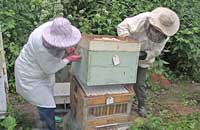
Пчеловодство в Ирландии имеет долгую историю, оно было основано святым Моллагой в VII в. при церкви Ланн Бичер (Церковь Пасечника) недалеко от г. Балбриггана.
Кочевое пчеловодство в этом графстве не распространено, и в целом завоз пчелиных семей в регион или перемещение внутри него достаточно ограничены. Исключение составляют местные ирландские матки темной лесной пчелы (Apis mellifera mellifera, линия Galtee), размножаемые в графстве Типперэри и особенно активно распространявшиеся в конце 1990 — начале 2000-х годов.
В Ирландию клещ Varroa destructor впервые был завезен в 1998 г., в течение последующих 5 лет он стал паразитировать во всей популяции местных пчел Apis mellifera mellifera. В 2010 г. в ходе естественного отбора в местной популяции пчел сформировалась устойчивость к клещу варроа.
В ходе исследований было показано, что местные пчелы выработали способ борьбы с клещом варроа путем физического повреждения их тела – идиосомы и конечностей. В результате упавшие на дно улья поврежденные клещи оказались практически неподвижными и не могли вернуться в гнездовой корпус.
Было показано, что температура внутри улья имеет критическое значение для развития пчелиной семьи и паразитирования клеща варроа. При использовании сетчатых доньев температура в ульях весной падает, что замедляет развитие расплода пчел и дает репродуктивное преимущество для клещей варроа.
Ключевые слова: A. m. mellifera, Varroa destructor, варроатоз.
Д. МАКМАЛЛАН, Р.А. ИЛЬЯСОВ1
Тринити-Колледж, Университет Дублина, Ирландия
1Институт общей генетики им. Н.И. Вавилова РАН, г. Москва
ЛИТЕРАТУРА
1. Coffey M.F. Biotechnical methods in colony management, and the use of Apiguard and Exomite Apis for the control of the varroa mite (Varroa destructor) in Irish honey bee (Apis mellifera) colonies // Journal of Apicultural Research. — 2007. — №46. doi: 10.1080/00218839.2007.11101397.
2. Davis A.R. Regular dorsal dimples on Varroa destructor — Damage symptoms or developmental origin? // Apidologie. — 2009. — №40 (2). doi: 10.1051/apido/2009001.
3. Ilyasov R.A., Lim S., Lee M.L., Kwon H.W., Nikolenko A.G. Effect of miticides amitraz and fluvalinate on reproduction and productivity of honey bee Apis mellifera // Uludag Bee Journal (Uludağ Arıcılık Dergisi). — 2021a. — №21 (1). doi: 10.31467/uluaricilik.883775.
4. Ilyasov R.A., Takahashi J.I., Proshchalykin M.Y., Lelej A.S., Lee M.L., Kwon H.W. et al. First evidence of presence of Varroa underwoodi mites on native Apis cerana colonies in Primorsky Territory of Russia based on COX1 gene // Journal of Apicultural Science. — 2021b. — №65 (1). doi: 10.2478/JAS-2021-0014.
5. Ingemar F., Scott C. Implications of horizontal and vertical pathogen transmission for honey bee epidemiology // Apidologie. — 2001. — №32 (3). doi: 10.1051/apido:2001122.
6. Lodesani M., V.M.a.T.S., Bigliardi M. A study on different kinds of damage to Varroa jacobsoni in Apis mellifera ligustica colonies // Journal of Apicultural Research. — 1996. — №35. doi: 10.1080/00218839.1996.11100912.
7. Manuela R.B., Neil A.C.K., Robert S.P. A comparative evaluation of sampling methods for Varroa destructor (Acari: Varroidae) population estimation // Apidologie. — 2006. — №37 (4). doi: 10.1051/apido:2006010.
8. Mcmullan J. Adaptation in honey bee (Apis mellifera) colonies exhibiting tolerance to Varroa destructor in Ireland // Bee World. — 2018. — №95 (2). doi: 10.1080/0005772X.2018.1431000.
9. Mcmullan J.B. Having healthy honey bees, an integrated approach FIBKA. — Dublin, 2012. isbn: 978-0-9571355-0-5.
10. Rosenkranz P., Aumeier P., Ziegelmann B. Biology and control of Varroa destructor // J. Invertebr Pathol. — 2010. — 103. — Suppl. 1. doi: 10.1016/j.jip.2009.07.016.
СВЕДЕНИЯ ОБ АВТОРАХ:
МакМаллан Джон, науч. сотр., e-mail:
Ильясов Рустем Абузарович, вед. науч. сотр., e-mail:
FORMATION OF NATURAL RESISTANCE TO THE VARROA DESTRUCTOR MITE IN THE POPULATION OF THE DARK FOREST BEE IN IRELAND
J. Mcmullan, R.A. Ilyasov
The Varroa destructor mite was first introduced to Ireland in 1998 and, over the next 5 years, began to parasitize the entire population of local Apis mellifera mellifera bees. Since 2010, in result of natural selection, the resistance to the V. destructor mite has developed in the population of A. m. mellifera in Ireland. As part of the study it was detected that the native Irish bees A. m. mellifera have developed a way to fight the parasitic mite Varroa by physically damaging its bodies — idiosomes and limbs. It was shown that the damaged mites that fell to the bottom of the hive were practically immobile and could not return to the nesting housing. It has been shown that the temperature inside the hive is critical for the development of the bee colony and the parasitism of the Varroa mite. Using the mesh floors in hives during the spring is able to drop the temperature in the hive, which will slow down the development of brood bees and will give a reproductive advantage to Varroa mites.
Keywords: A. m. mellifera, Varroa destructor, varroatosis.


 Адрес редакции журнала "Пчеловодство":


